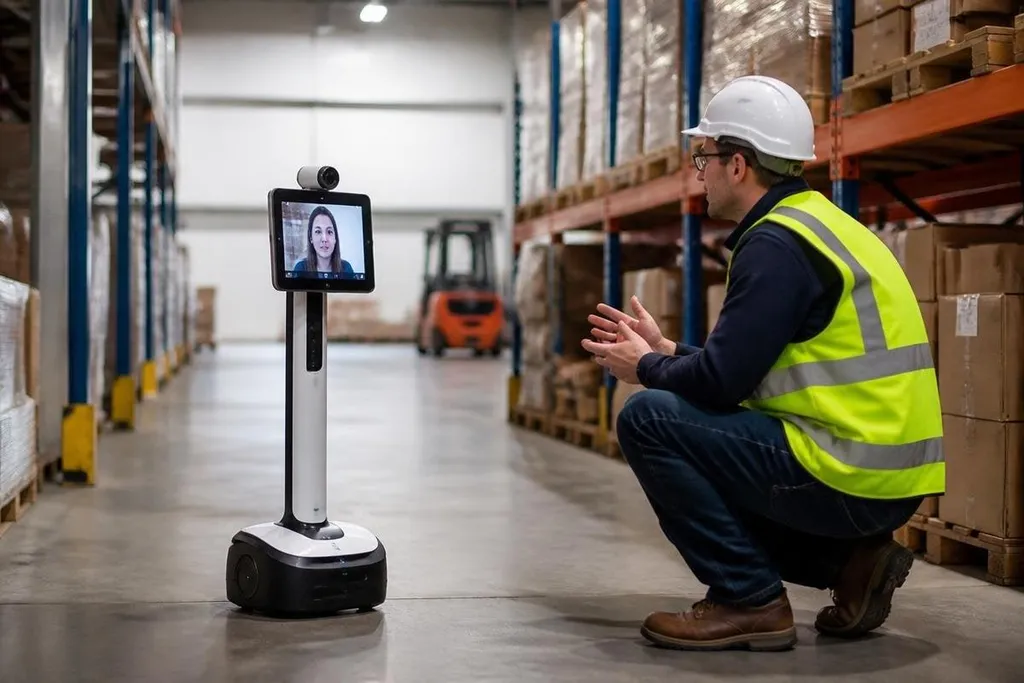
A telepresence robot lets someone see, hear, speak, and move through a remote site without travelling there. Its future will depend less on human-shaped hardware and more on whether it handles useful work with low delay, safe movement, and a clear reason to exist.
Quick read
- Remote presence works best when travel is costly or access is limited.
- Better cameras and network links can improve a visit, but they cannot remove every physical limit.
- Buyers should test the full task, not the robot’s video feed alone.
Where telepresence robots fit
A telepresence robot usually combines a mobile base, cameras, microphones, speakers, and a remote control interface. Some models add a screen that shows the operator’s face, while others focus on a camera view from the robot.
That setup can help a remote worker attend a meeting, inspect a room, speak with staff, or move through a site. The value comes from presence at a distance. If a normal video call gives enough access, a moving robot may add cost without adding much use.
The strongest cases involve places where a person needs to look around, choose where to stand, or respond to something that was not planned in advance. A fixed camera cannot follow a changing conversation or inspect a new area on request.
The limits are physical
A remote operator still depends on the robot’s wheels, sensors, battery, network link, and surroundings. A narrow doorway, a floor edge, a crowded corridor, or a weak wireless signal can stop the visit before the conversation is finished.
Control delay matters too. When the video arrives late, steering becomes harder because the operator acts on an old view. A robot that moves well in an open office may need a slower mode near people, furniture, stairs, or door thresholds.
Audio can cause trouble in another way. The robot may reach a room, yet the person on the other side may struggle to hear the operator over fans, machinery, or several people speaking at once. A better camera cannot fix a poor microphone position.
What may improve next
The next useful step is better assistance during remote driving. Software may help keep the robot away from walls, suggest a clear route, or stop the base when a person enters its path.
Those functions can reduce the operator’s workload, but they do not remove the need for human control in uncertain spaces.
Battery charging and docking also matter. A robot that needs frequent help from a local worker can shift work rather than remove it. Future designs will need a clear way to charge, recover from a blocked route, and report faults to someone nearby.
The user interface has room to improve as well. A remote worker needs to see where the robot is, what it can reach, and why it stopped. Controls that expose too many low-level settings slow the visit; controls that hide every limit make mistakes harder to diagnose.
That interface limit affects whether a telepresence robot earns a place in daily work. A report from Robot24.com can tie a system’s controls to its task, site, and human operator. Those details lead directly to the business case.
The business case
Telepresence robots make more sense when a remote visit replaces a costly trip, reduces a delay, or gives a specialist access to a place they cannot reach easily. The calculation must include setup, support, charging, network access, and help from people at the site.
Privacy will shape adoption. A moving camera can enter spaces that were outside a fixed camera’s view, so people need clear rules about when recording happens, who can drive, and where the robot may go. A screen showing the remote visitor can make the interaction easier to understand, but it does not answer those policy questions.
I’d skip a telepresence robot when the task is only a scheduled video call. The case is stronger when movement, inspection, or remote attendance changes what the operator can do.
A practical buying checklist
Use these checks before you compare models:
- Map the route: measure doors, lifts, floor changes, and the spaces the robot must reach.
- Test the network: run the robot where it will work, including rooms with weak signal.
- Watch the battery: record how long a normal visit lasts and how charging will happen.
- Check the controls: ask a remote operator to drive, stop, turn, speak, and recover from a blocked path.
- Set privacy rules: decide who may connect, where the camera can point, and how recordings are handled.
- Price local help: include the time needed to move, charge, clean, and restart the robot.
The future of telepresence robots will be decided by these small working details. A system that gives remote staff reliable access to a place may earn its cost; one that only puts a face on wheels will need a better reason to stay.